At a glance
Labourd (Lapurdi in Basque) takes its name from Lapurdum, a Roman military post on the site of present-day Bayonne (Baiona). Bounded by the Adour to the north, the Bidasoa to the south, the ocean to the west and Lower Navarre (Nafarroa Beherea) to the east, it covers 858 km² (including Bayonne and Boucau) and is the most populous of the three Basque provinces in France.
From the 1850s, its beaches drew Europe’s crowned heads — Empress Eugénie persuaded Napoleon III to make Biarritz their holiday retreat — and then, from the mid-1950s, the first surfers.
A little history
- Antiquity: a Roman fortress, Lapurdum, occupies the site of Bayonne; it appears in the Notitia Dignitatum (4th–5th century).
- Middle Ages: attached to Aquitaine, Labourd passes to the English with the marriage of Eleanor of Aquitaine and Henry II Plantagenet (1152). Bayonne would remain English for 300 years.
- 1451: the French retake it.
- 16th–17th centuries: Sephardic Jews fleeing the Inquisition settle in Bayonne and introduce chocolate there.
- French Revolution: the Biltzar, the assembly of Labourd that sat in Ustaritz, disappears with the abolition of privileges (night of 4 August 1789). In 1790 the province is merged into the Basses-Pyrénées department (now Pyrénées-Atlantiques).
- 1854: Napoleon III and Eugénie stay in Biarritz, where the emperor has the Villa Eugénie built; the resort becomes fashionable.
- 1956: the American screenwriter Peter Viertel, in Biarritz for the filming of The Sun Also Rises, has his surfboard sent over from California: the beginning of surfing in France.
Must-see sights
- Biarritz — the Grande Plage, the Rocher de la Vierge (Virgin’s Rock) and its footbridge, and the Art Deco sea museum (Musée de la Mer).
- Bayonne — the old town with its red and green half-timbered façades, the Gothic Sainte-Marie Cathedral, the Vauban ramparts, the Nive, the Basque Museum (Musée Basque).
- Saint-Jean-de-Luz — the fishing port, the church of Saint-Jean-Baptiste (where Louis XIV married Maria Theresa in 1660), and the bay enclosed by its sea walls.
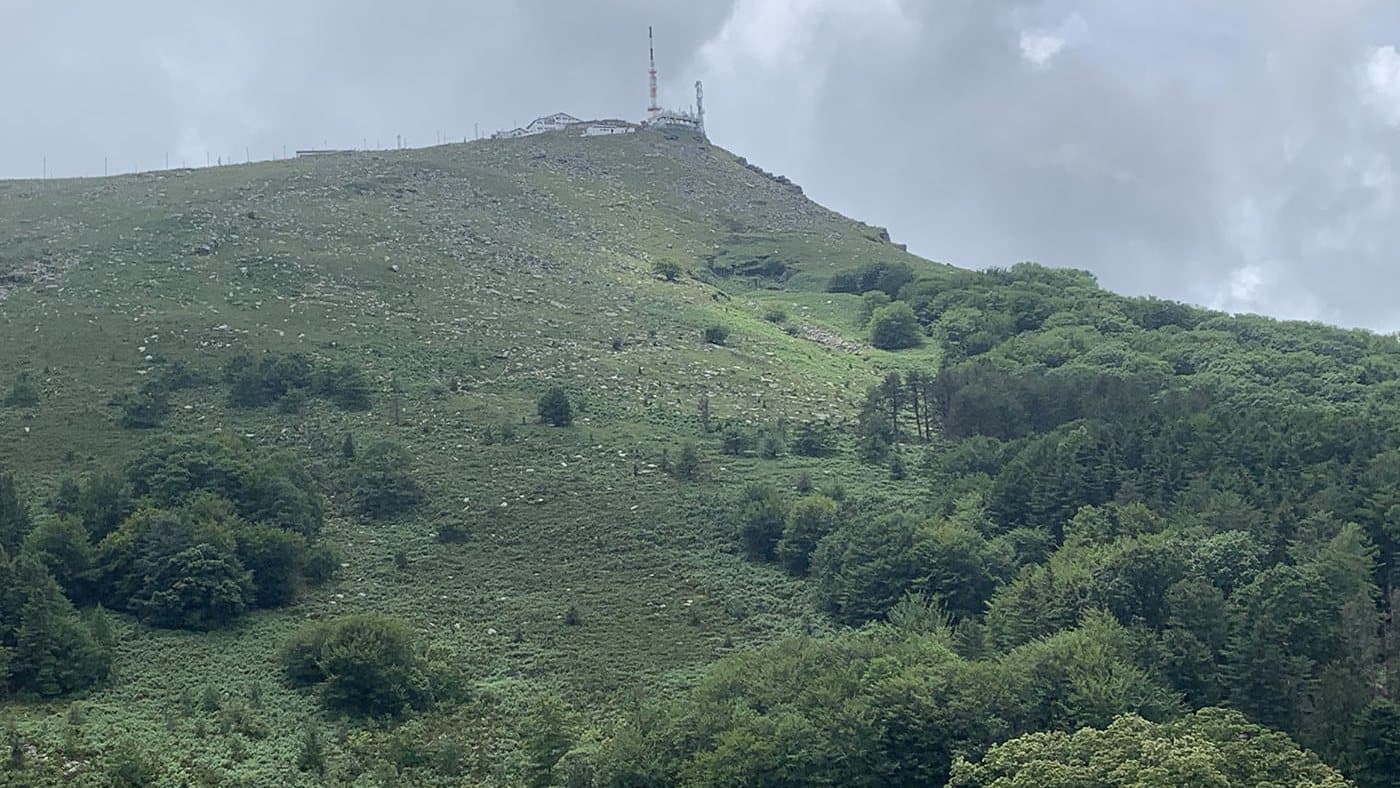
- La Rhune (Larrun) — the emblematic summit (about 900 m), reached by the little rack railway running since 1924, with views over the Basque Country, the Landes and the ocean.
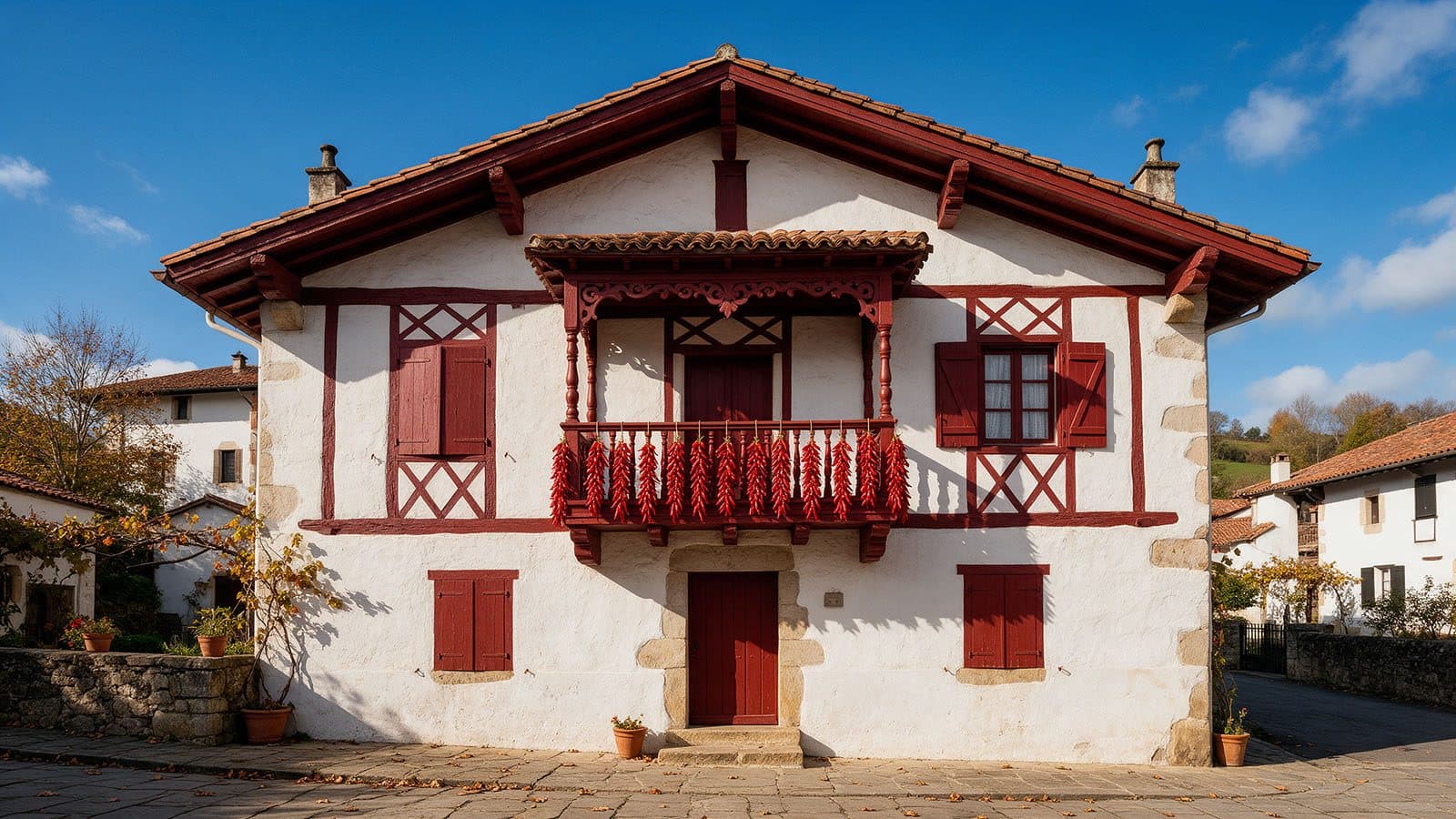
- Espelette — the village whose façades are hung with drying chillies, and its chilli festival on the fourth weekend of October.
- Sare and Ainhoa — two of the ‘Most Beautiful Villages of France’ (Les Plus Beaux Villages de France).
- Sare Caves — probably occupied as early as the Aurignacian, open to the public.
- Corniche basque — 6 km of cliffs between the port of Socoa (Ciboure) and Hendaye beach. The coastal path there has been closed to walkers since 2013 (erosion); an alternative route runs through the hills and the Abbadia estate.
- Villa Arnaga in Cambo-les-Bains — Edmond Rostand’s house (1903–1906), now a museum, with 15 hectares of French- and English-style gardens, listed as a historic monument (monument historique) and as a ‘Remarkable Garden’ (jardin remarquable).
Main towns
- Bayonne (Baiona) — chocolate, ham, Gothic architecture
- Biarritz — surfing and the Belle Époque
- Saint-Jean-de-Luz (Donibane Lohizune) — royal port
- Anglet — 4.5 km of beaches
- Hendaye (Hendaia) — border town and long beach
- Espelette (Ezpeleta) — home of the PDO chilli
- Cambo-les-Bains (Kanbo) — spa town
- Sare (Sara) — one of the Most Beautiful Villages of France
- Ascain (Azkaine) — at the foot of La Rhune
- Ustaritz (Uztaritze) — former seat of the Biltzar of Labourd
- Itxassou (Itsasu) — black cherries and the Pas de Roland
- Saint-Pée-sur-Nivelle (Senpere) — lake and the Nivelle valley
- Bidart (Bidarte) — beaches and the Chapelle de la Madeleine
- Ainhoa — one of the Most Beautiful Villages of France
Must-try food and drink
- Bayonne ham (PGI) — salted with salt from the Adour basin salt works (Salies-de-Béarn), cured for at least 7 months under the product specification, 9 to 12 months in practice
- Bayonne chocolate — introduced by Sephardic Jews
- Espelette pepper (PDO) — moderately hot (4 on the simplified Scoville scale) and fragrant
- Gâteau basque — shortcrust pastry filled with pastry cream or black cherry jam (Itxassou is famous for its cherries)
- Axoa — diced shoulder of veal, cooked with sweet peppers, onions and Espelette pepper
- Ossau-Iraty cheese (PDO) — made from sheep’s milk (French AOC since 1980)
Living traditions
- Basque pelota — frontons and trinquets are part of the village landscape.
- The Fêtes de Bayonne — 5 days in July, more than a million festayres (revellers; 1.1 million in 2025), in the traditional white and red.
- Bullfighting — Bayonne keeps up a strong bullfighting tradition, contested but alive.
- Basque strength sports (force basque) — straw-bale lifting, tug of war and log sawing at village fêtes.
Curiosities and anecdotes
- Espelette pepper is thought to have reached the Basque Country in the 16th century, brought back from the Americas. In Ramuntcho (1897), Pierre Loti compares the chillies drying on the façades to ‘beautiful strings of coral beads’.
- The makhila, the traditional Basque walking stick, is still made by hand in Larressore, at the Ainciart Bergara workshop, one of the oldest still in operation. This craft is listed in France’s Inventory of Intangible Cultural Heritage (Inventaire du patrimoine culturel immatériel en France).
Photographing Labourd
The spots not to miss for your feed:
- Rocher de la Vierge (Biarritz) at sunset, with its footbridge
- Villa Belza (Biarritz) — the lone villa on its headland, in the mist
- Saint-Jean-de-Luz harbour from Ciboure — the colours of the Basque houses facing the boats
- Espelette in October — entire façades covered in drying red chillies
- La Rhune summit at dawn — free-roaming pottoks (Basque ponies) on the slopes, views all the way to the ocean
- Corniche basque between Socoa and Hendaye — cliffs and ocean, from the permitted routes
- Bayonne’s covered market (Les Halles) — stalls of chillies, hams and cheeses