Culture
Lauburu: the origin and meaning of the Basque cross
Where does the lauburu, the Basque cross, come from, and what does it mean? What the old stelae show, what it has been made to mean, how to draw it with a compass, where to see the oldest ones, and a detour via the ikurriña.
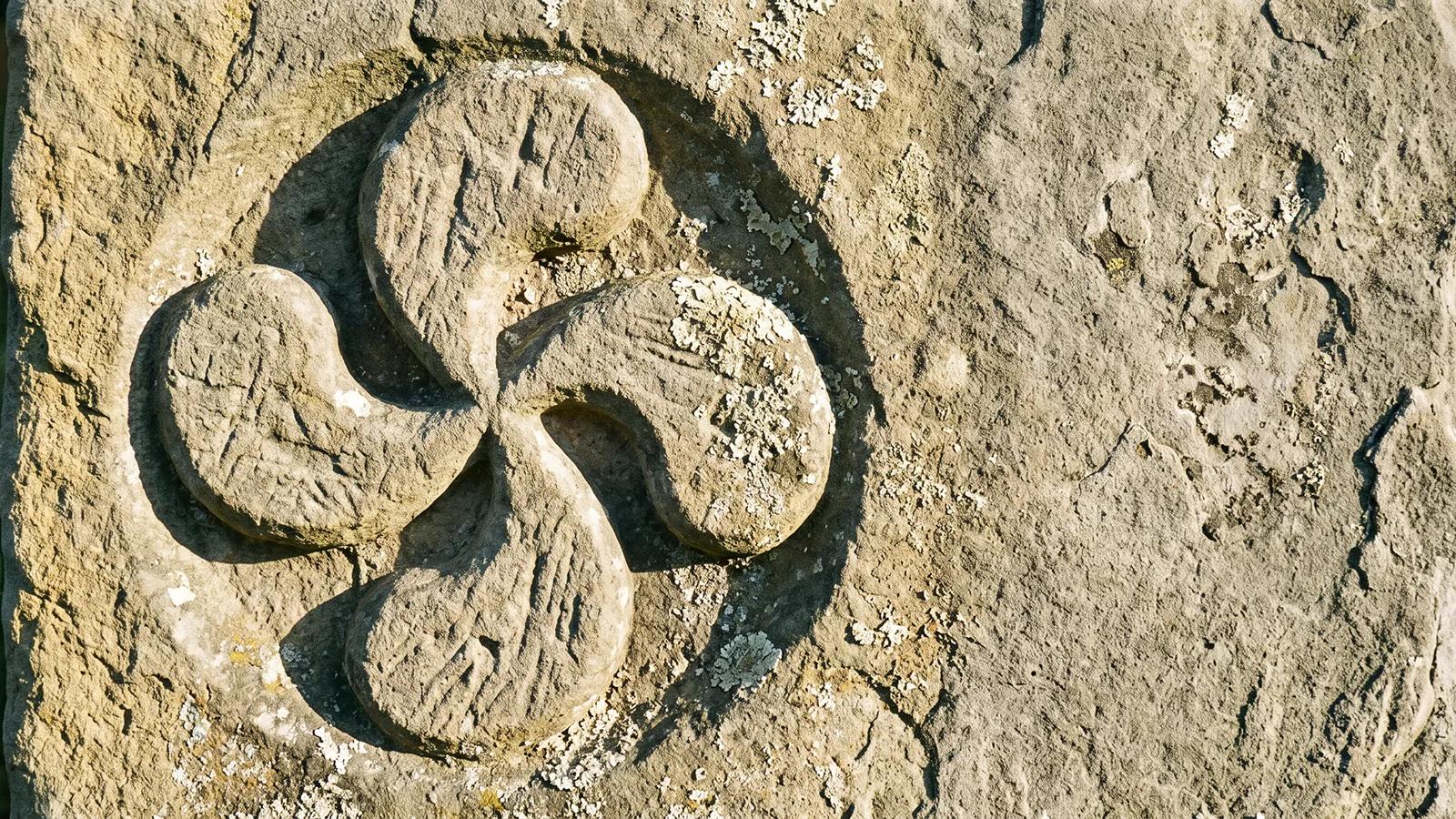
The lauburu, the Basque cross, is four comma-shaped heads turning around a single centre. Its name says exactly that: lau buru, 'four heads'. You see it everywhere, from lintels to jewellery, from Bayonne ham to the logo of this site. But where does it come from, and what does it mean? The short answer: we know where and when it appears on stone, at the end of the 16th century, and almost nothing about what it meant. Everything else is interpretation, and often recent.
In this guide: what the stelae show, what people have wanted it to mean, how to draw it with a compass, where to see the oldest ones, and a detour via the ikurriña, the flag, which is sometimes confused with it.
I chose it as the logo for this site because it carries no flag: it sits on a grave in Lower Navarre as readily as in a shop window in Bilbao, and nobody asks it for its papers.
In brief
- Four commas around a centre, all turning the same way. Lau buru means 'four heads'.
- The oldest dated curved lauburus go back to the late 16th or early 17th century; the motif spreads in the 17th and above all the 18th century, on stelae, lintels and chests.
- Sun, four elements, four provinces: none of these meanings appears in the old sources. It is first of all a decorative motif, which became an emblem in the 20th century.
- It has nothing to do with the Nazi swastika, which is rectilinear. Even the link with the ancient swastika is unproven: fifteen centuries without a single example in the Basque Country.
- It can be drawn with a ruler and compass in five minutes. The diagram is further down.
What exactly is the lauburu?
The lauburu is a motif with four curved arms. Each arm is a thick comma, round head outwards and point towards the centre, and all four turn the same way. In French it is the croix basque, in English the 'Basque cross'; ethnographers speak of a 'curved swastika' to distinguish it from the rectilinear form, with its straight, bent arms.
The word comes from the Basque lau, four, and buru, head: that is the etymology given by the general dictionary of the Basque Language Academy (Euskaltzaindia). Another hypothesis, put forward in the 19th century by the Jesuit Fidel Fita, saw in it the labarum, the Roman standard; it has never been substantiated.
Philippe Veyrin, who studied the motif in Basque folk art, describes it simply: a comma obtained by dividing a circle into two equal parts with a sinuous curve. Four circles, four commas, one lauburu. That is also the key to drawing it.
What the stones say
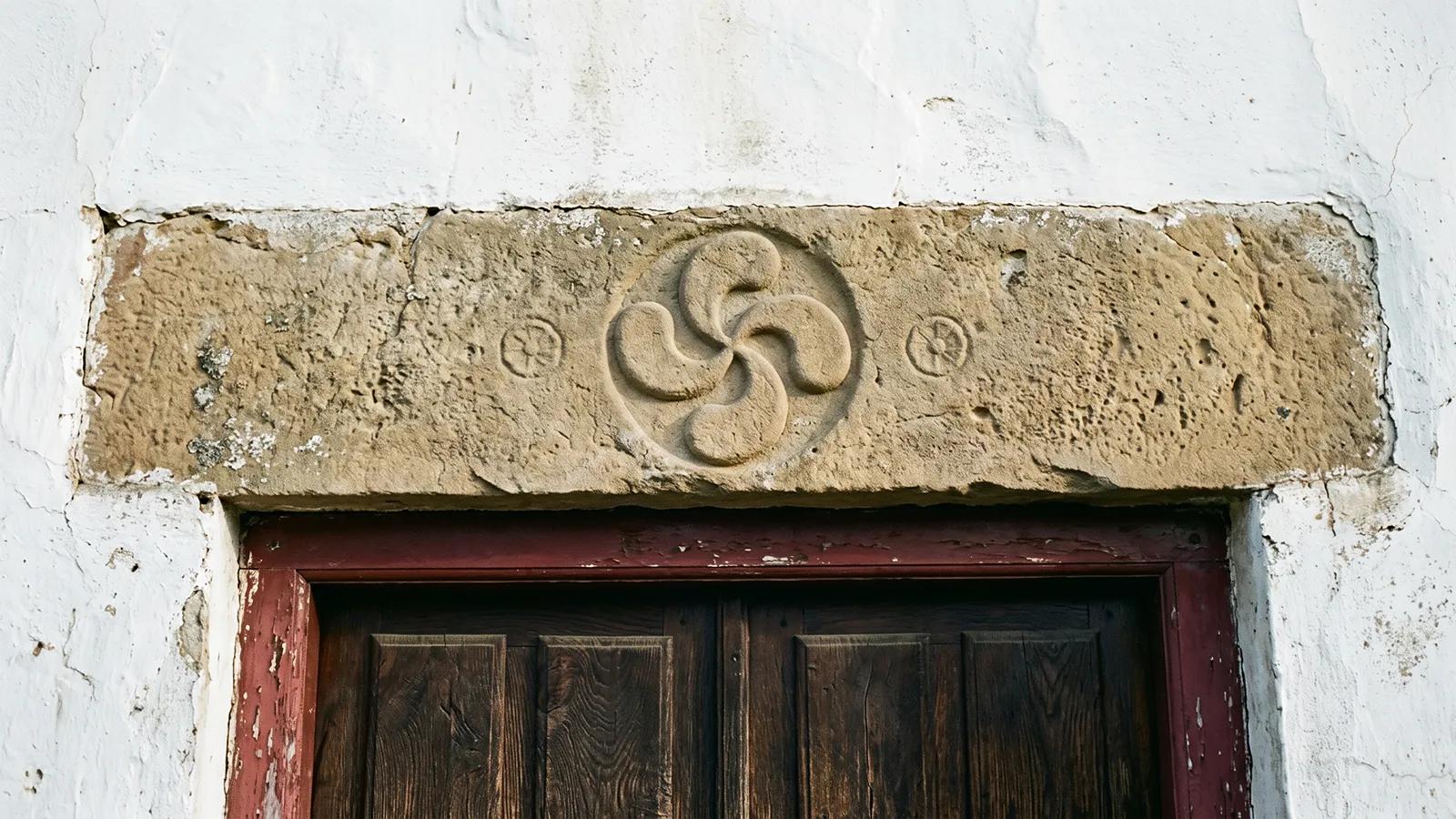
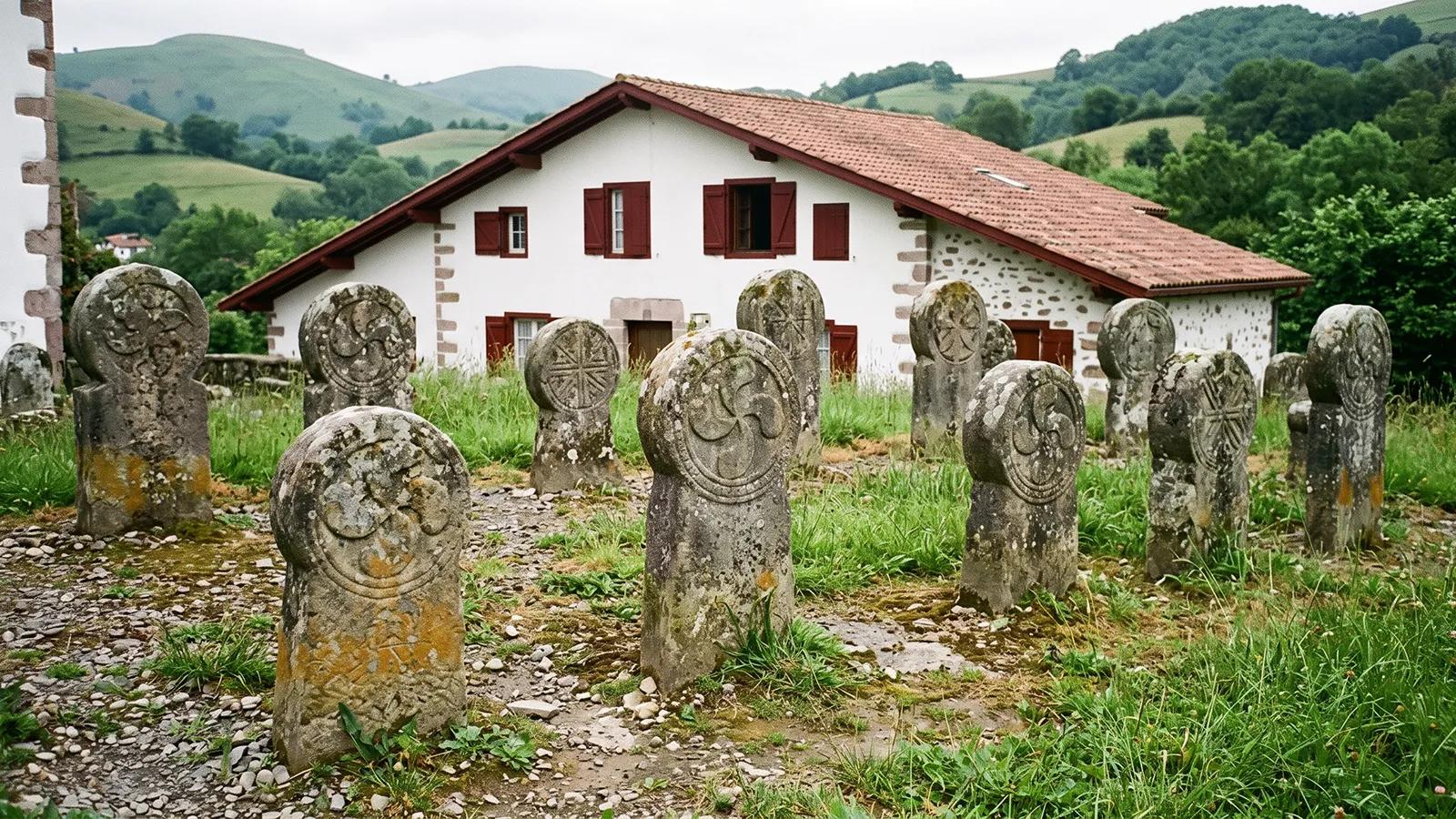
The oldest known curved lauburu dates from the late 16th or early 17th century, at Macaye (Makea), near Hasparren. The motif becomes common in the 17th century and multiplies in the 18th, above all in Lower Navarre, Navarre and Labourd (Lapurdi). It is carved on the discoidal stelae of churchyards, on house lintels, on gravestones, on wooden chests.
One detail unsettles received ideas: in his inventory of the 1930s, the ethnographer Pedro Garmendia knew of no old example in either Biscay or Álava. And the motif is not unique to the Basque Country. It is found in Béarn, in the Hautes-Pyrénées, in Alsace, in the Aisne, in the Tyrol. The lauburu is Basque because of what the Basques have made of it, not through any monopoly.
The discoidal stelae, hilarriak in Basque, are the best place to see it. A stone disc on a trapezoidal base, facing the rising sun, decorated with rosettes, crosses, the tools of the deceased and turning motifs such as the lauburu. They are dated from the 16th century onwards, and the churchyard at Itxassou alone has more than two hundred.
And before the 16th century?
This is where things get complicated. Rectilinear swastikas certainly exist in Antiquity, in the Basque Country as elsewhere: on a Roman cippus of the Varduli cohort, on the stele of Santacara in Navarre. Then nothing. The historian Camille Jullian noted a gap of some fifteen centuries without a single example, straight or curved, between the Roman period and modern times.
Specialists are split between two positions. Garmendia judged a line of descent probable but unproven. Veyrin rejected any link with the ancient swastika: for him, the lauburu is born from the assembly of commas, a decorative motif sufficient unto itself. No discovery has settled the matter since.
What it has been made to mean
Over the past two centuries, the lauburu has been given more meanings than it has arms. None rests on a source earlier than the 19th century.
- The four regions of the Basque Country. This is the reading of Augustin Chaho, in 1847, in his Histoire primitive des Euskariens-Basques.
- The sun. Sabino Arana, founder of Basque nationalism, saw in it proof of an ancient solar cult; the daily Euzkadi took up this reading from its very first issue, in 1913. It rested on etymologies since recognised as false.
- A healer's sign. Louis Colas, author of La Tombe basque in 1923, linked it to the signs of Paracelsus and thought it marked the graves of those who healed animals, or souls.
- The four elements, life, luck. These are today's readings, those of the shops and jewellers. They are neither false nor true: they are recent.
Garmendia concluded, as early as the 1930s, that decorative use was probably the only real meaning of the lauburu in the modern era. Nearly a century later, nothing has come to contradict him.
The lauburu has no secret. It has a history, and it is carved in stone, not written in books.
From motif to emblem
The shift from decoration to symbol takes place between the late 19th and early 20th centuries. The nascent Basque nationalist movement was looking for ancient signs; the lauburu was one, and it was everywhere on the old stones. It found its way onto the flags of political organisations, such as that of Basque Nationalist Action (ANV), but never onto the official arms of the seven provinces, nor onto the ikurriña. Garmendia already noted that Arana's solar reading had revived the fashion for the rectilinear form, the one that causes confusion today.
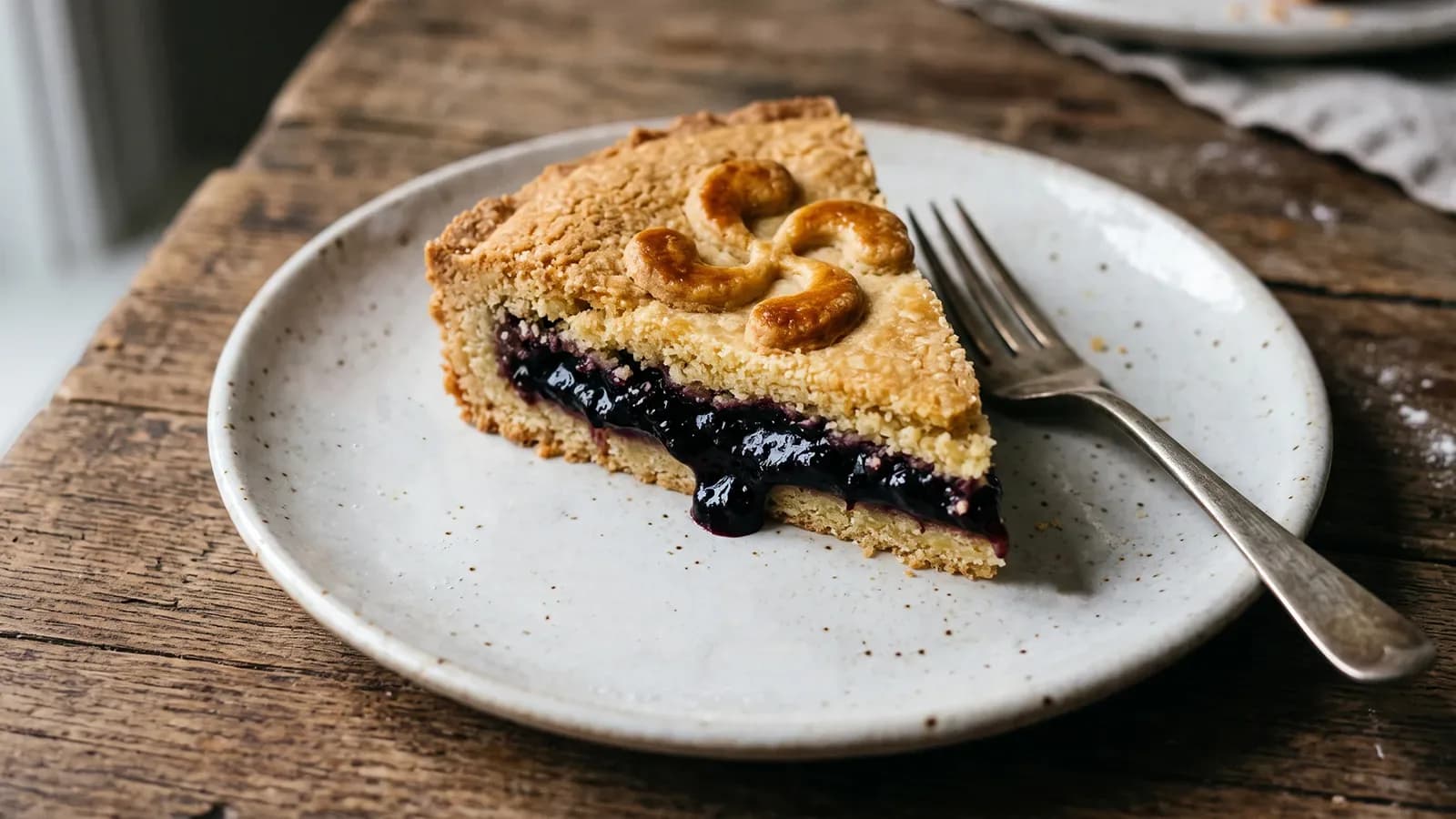
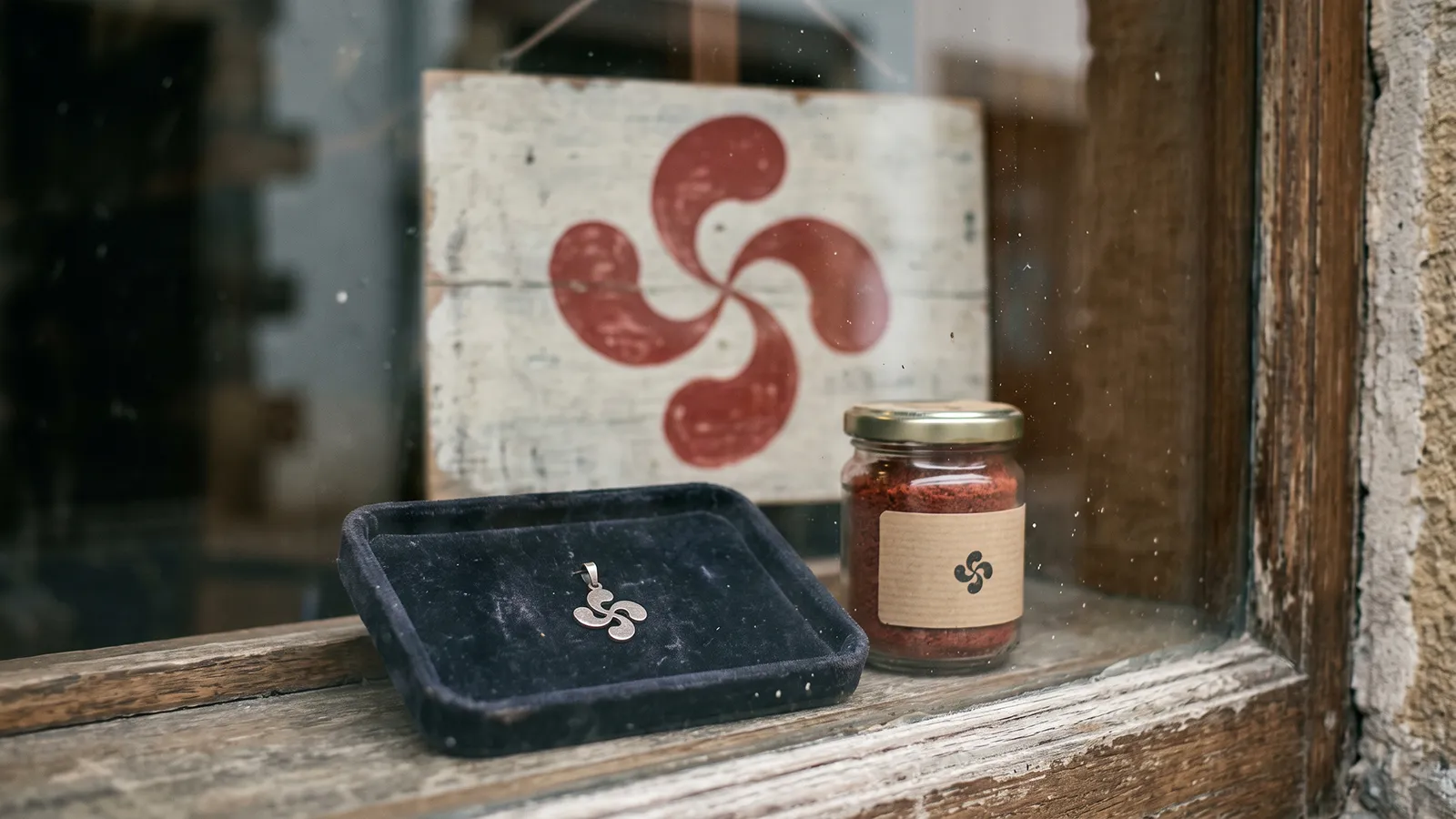
Under Franco, whose regime repressed expressions of Basque culture, its use declined. Since the end of the dictatorship it has come back everywhere, and above all where it had never been: above doors as a good-luck charm, on shop windows, jewellery, labels, skin. It guarantees the origin of Bayonne ham, branded onto the rind. It marks the cherry version of the gâteau basque at many bakers'. And it signs this site.
How to draw a lauburu with a compass
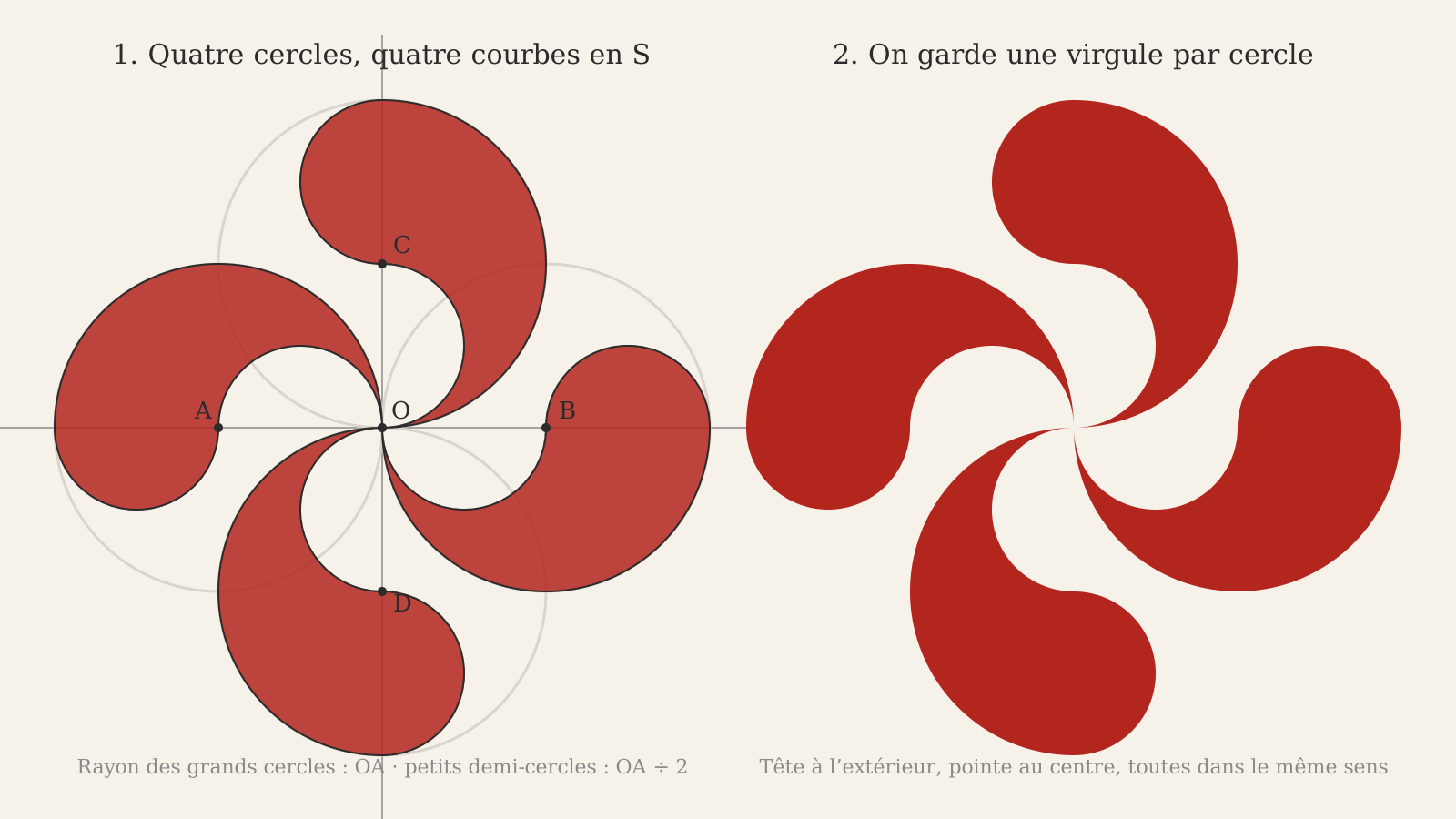
You need a ruler, a compass and five minutes. The measurements below give a lauburu 12 cm across; for another size, replace 3 cm with the length of your choice, and 1.5 cm with half of it.
- Draw two perpendicular lines crossing at O. On the horizontal, mark A and B 3 cm from O; on the vertical, C and D 3 cm from O.
- Draw the four circles of radius 3 cm centred on A, B, C and D. Each passes through O.
- On the horizontal line, mark E and F 1.5 cm either side of A. Draw a semicircle of radius 1.5 cm centred on E, above the line, and another centred on F, below it. Together they form an S-curve that cuts the circle around A into two commas.
- Do the same around B, then around C and D, this time drawing the semicircles to the right and left of the vertical.
- In each circle, keep the comma whose point reaches O and whose round head is on the outside. All four must turn the same way. Rub out the rest and fill in.
Where to see old lauburus
The churchyard at Itxassou. Around the church of Saint-Fructueux, more than two hundred discoidal stelae, one of the richest collections in Labourd. Look, don't touch, and keep to the paths.
The Discoidal Stelae Interpretation Centre at Larceveau. In Lower Navarre, in the centre of the village, an open-air trail, Harriak Iguzkitan, 'the stones in the sun', presents a collection of stelae, with a video room in four languages. Open all year from 9 am to 9 pm, self-guided.
Village churchyards. In Labourd, Lower Navarre and Navarre, most old churchyards have kept their stelae. The one at Ainhoa, around the church, has stelae from the 16th and 17th centuries.
The museums. The San Telmo Museum in San Sebastián holds stelae in its archaeology collections; the Basque Museum (Musée Basque et de l'histoire de Bayonne) in Bayonne is worth the detour for its collections of everyday objects.
And the ikurriña?
The two are sometimes mixed up, because they travel together in the same shop windows. Yet they are neither the same age nor the same kind of thing. The lauburu is a popular motif four centuries old, with no author. The ikurriña is a flag designed in 1894 by two brothers, and it has official status.
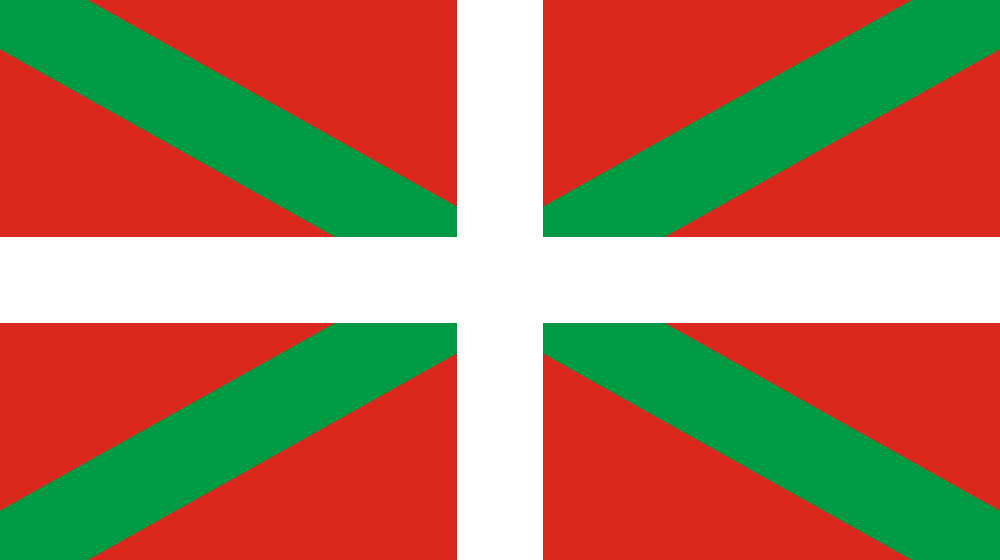
The word. Ikurriña simply meant 'flag', formed from ikur, the sign. It now refers to this one alone.
The birth. In the summer of 1894, in Bilbao, Sabino Arana sketched a flag for Biscay; his brother Luis gave it its shape and colours. It was raised on 14 July 1894 at the opening of the Euskeldun Batzokija, the first nationalist club. It was conceived for Biscay alone; the rest of the Basque Country would adopt it later.
The colours. The red field comes from the old flag of Biscay; the white cross from the silver cross of its arms and from the Christian faith; the green St Andrew's cross from the oak of Gernika, symbol of Basque liberties.
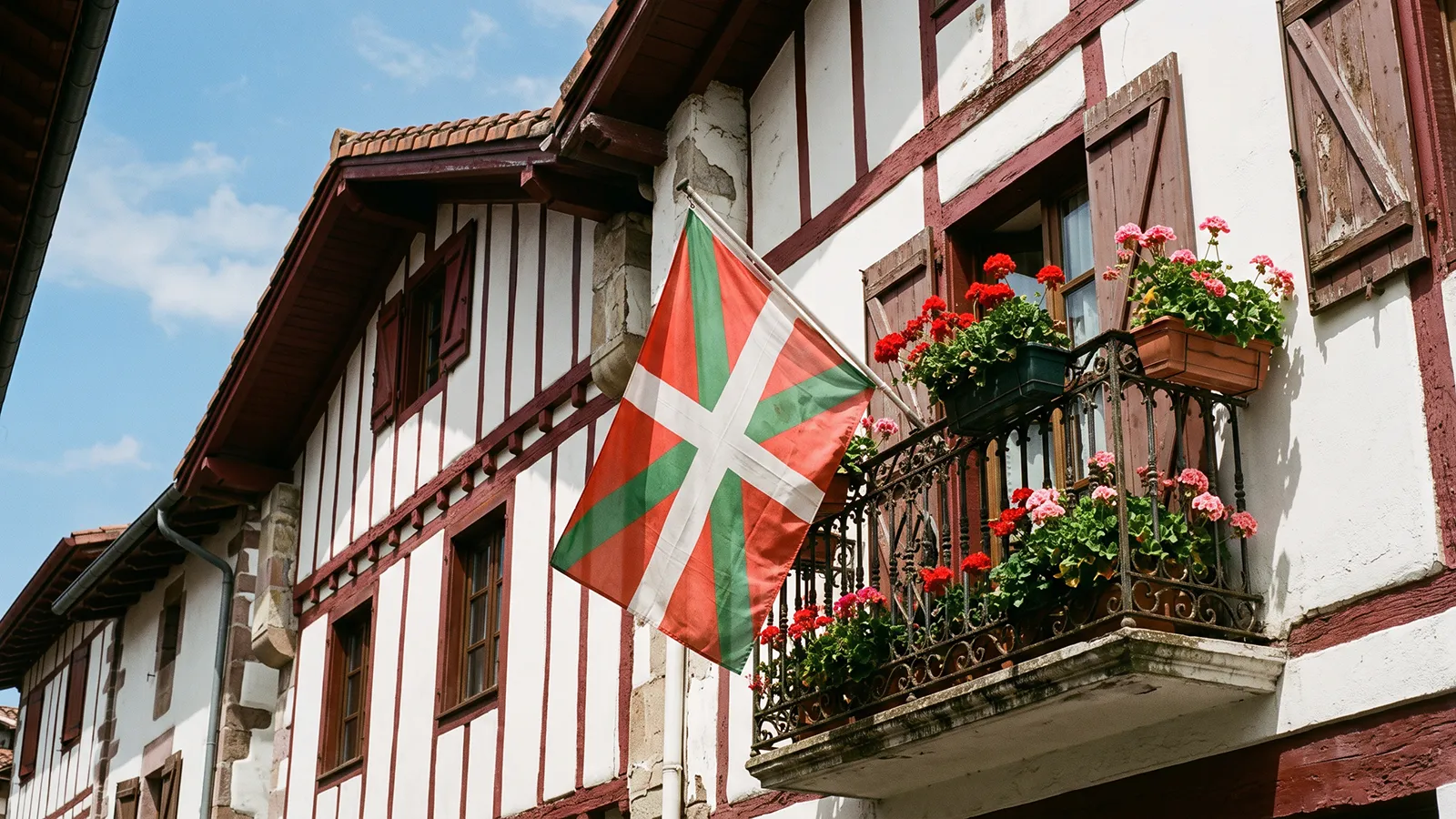
The status. In October 1936, the first Basque government made it by decree the flag of autonomous Euskadi. Banned after the Civil War, it remained in use on the French side of the border, where it was never prohibited, and flew over town halls in Iparralde alongside the French flag after the Second World War. On the Spanish side it was tolerated in January 1977, on the eve of the Tamborrada in San Sebastián, then legalised the same year. Since 1979, article 5 of the Statute of Autonomy of Gernika has made it the official flag of the Basque Autonomous Community. In Navarre it has no official status.
The proportions. A rectangle of 14 by 25, crosses 8.6% of the length wide, Pantone 485 red and Pantone 347 green, laid down by the 1999 regulation.
Frequently asked questions
Are the lauburu and the swastika the same thing?
No. The Nazi swastika is a rectilinear swastika, with straight, bent arms, adopted in 1920 and with no connection whatsoever to the Basque Country. The lauburu is curved, made of commas, and appears on Basque stones at the end of the 16th century. The two may descend, very distantly, from a single ancient motif; nothing proves it, and fifteen centuries separate them.
Which way should a lauburu turn?
On the old stelae it most often reads clockwise. You will hear that one direction stands for life and the other for death: that reading appears in none of the old sources consulted here. Both directions exist, and neither is a mistake.
Is the lauburu a political symbol?
It appeared on party flags in the 20th century, but it is on neither the ikurriña nor the official arms. Today you meet it above all as a mark of origin and belonging: shop signs, products, jewellery. The political and official symbol is the ikurriña.
Why is it called the 'Basque cross'?
It is the French and English name, used for convenience. The lauburu is not shaped like a Latin cross, but it has adorned Christian graves for four centuries, alongside crosses and rosettes, and the name stuck. In Basque it is lauburu, and nothing else.
What is the difference between the lauburu and the ikurriña?
The lauburu is a popular decorative motif, attested since the late 16th century, with no inventor and no status. The ikurriña is a flag created in 1894 by Sabino and Luis Arana, official in the Basque Autonomous Community since the 1979 Statute. One is carved, the other is hoisted.
Sources
- Pedro Garmendia, 'La Swástika', Anuario de Eusko-Folklore (in Spanish) — PDF on eusko-ikaskuntza.eus (dating of Macaye, spread, interpretations)
- Philippe Veyrin, Le svastika courbé et autres motifs virguloïdes dans l'art populaire basque (1948 paper, Eusko Ikaskuntza, 2003, in French) — catalogue entry
- Santiago de Pablo, 'El lauburu. Política, cultura e identidad nacional en torno a un símbolo del País Vasco', Memoria y Civilización, 12, 2009 (in Spanish) — revistas.unav.edu
- Michel Duvert, 'Recherches sur les stèles basques', Archéologie en Languedoc, 1980 (in French) — PDF (more than two hundred stelae at Itxassou)
- Wikipedia — Lauburu; Wikipedia — Hilarri; Buber's Basque Page — The Lauburu
- Programme de construction n° 13 : la croix basque (Normandy education authority, in French)
- Discoidal Stelae Interpretation Centre, Larceveau (in French)
- Ikurriña: North American Basque Organizations — Ikurrina; Flags of the World — Basque Country (proportions, decrees, 1999 regulation); Gran Enciclopèdia Catalana — Ikurrina (in Catalan); El Debate — La ikurriña, reciente enseña del País Vasco (in Spanish; 1894, Euskeldun Batzokija, January 1977)
Ikusi arte — see you soon.